Why AI Agents Beat Chatbots for Real Business Automation
Most businesses start with a chatbot. Most businesses outgrow it in 90 days. Here's the fundamental difference between a chatbot and an agent — and why it matters for your automation ROI.
Most businesses that come to us have already tried a chatbot. They built it, deployed it, and watched it answer the same five questions on repeat while the real work — the approvals, the data entry, the escalations — still landed on someone's desk.
The problem isn't the technology. The problem is the category.
Chatbots Answer. Agents Act.
A chatbot is a response machine. It waits for a question, searches its training data, and returns an answer. The conversation ends there.
An AI agent is a reasoning system. It receives a task, figures out what needs to happen, retrieves the right data, uses the right tools, and does the work — end to end, without a human in the loop for every step.
That's not a subtle difference. That's the difference between a FAQ page and an employee.
What "Taking Action" Actually Means
When we say an agent takes action, here's what that looks like in practice:
- A customer support agent doesn't just answer "where's my order" — it queries your fulfillment API, checks the carrier, and sends a personalised tracking update
- A data agent doesn't just say "Q3 revenue was up 12%" — it pulls from your database, builds the chart, and emails the report to your team at 8am every Monday
- A document agent doesn't just summarise a contract — it extracts the key clauses, flags anomalies against your standard terms, and routes it to the right person for review
The agent doesn't just know the answer. It handles the situation.
The Three Things That Separate Agents from Chatbots
1. Retrieval over recall
Chatbots are limited by what they were trained on. Agents use retrieval-augmented generation (RAG) — they connect to your live data: your CRM, your database, your documents, your APIs. They answer with your information, not the internet's approximation of it.
2. Tool use
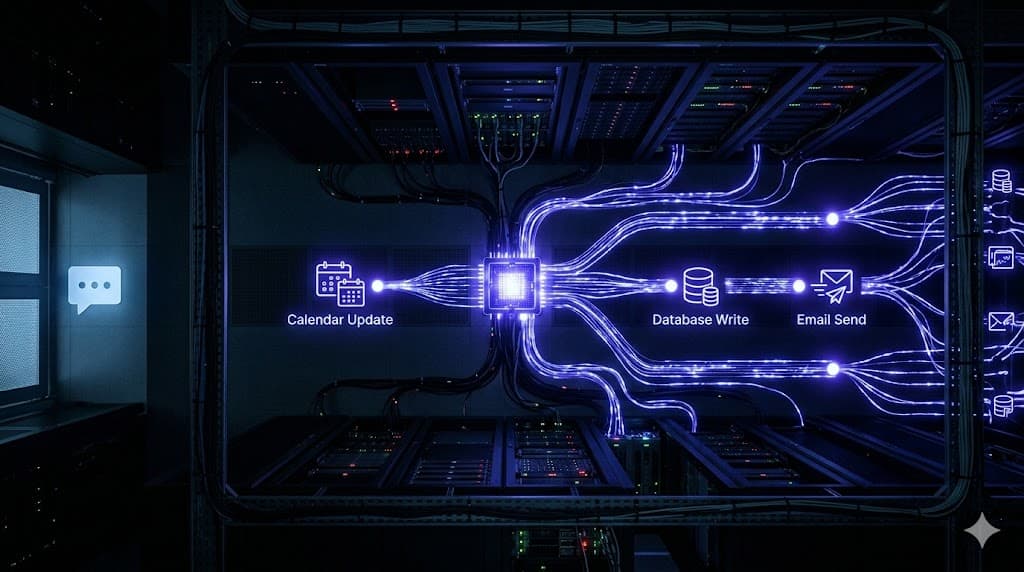
Chatbots talk. Agents do. A properly built agent has tools: the ability to call APIs, write to databases, send emails, create tickets, update records. The conversation isn't the end of the process — it's the start of it.
3. Multi-step reasoning
Chatbots respond to one input with one output. Agents can handle workflows that span multiple steps, decisions, and systems. "Process this invoice, check it against our vendor list, flag anything over $10K, and route it to finance" is one instruction to an agent. To a chatbot, it's five separate conversations that still end with a human doing the work.
Why This Matters for Your Business
The ROI calculation is completely different.
A chatbot reduces the volume of inbound messages your team handles. That's valuable — but capped. You still need humans for everything that requires action.
An agent reduces the workload itself. When an agent handles 80% of support tickets end-to-end, you're not just deflecting questions — you're eliminating work. When an agent generates your weekly pipeline report automatically, you're not saving 10 minutes of reading — you're reclaiming 3 hours of someone's Monday.
That's the shift from cost reduction to capacity creation.
When a Chatbot Is Actually the Right Choice
To be fair: there are cases where a chatbot is the right tool.
If you need a simple FAQ layer on your website, a basic lead capture form, or a lightweight intake process — a chatbot is faster to build and cheaper to run. Don't over-engineer it.
But if you're trying to automate a workflow that currently requires a human to retrieve information, make a decision, and take an action? That's an agent problem. And throwing a chatbot at it is how you end up with a tool your team works around instead of with.
The One Question to Ask
Before you build anything, ask this: "Does this workflow end with a human doing something, or does it end with an answer?"
If it ends with an action — an update, a send, a route, a create — you need an agent.
If it ends with an answer — a lookup, a summary, a response — a chatbot might be enough.
The distinction sounds simple. But it's the difference between automation that removes work and automation that moves it.
Rightshift builds custom AI agents for businesses that are ready to automate workflows, not just answer questions. If you have a process that needs to act, not just respond — book a discovery call.
Ready to automate your first workflow?
Book a free 30-minute discovery call. We'll scope the build and give you a clear quote — no commitment required.
Book a Discovery Call